Finding the right camera attachment for a microscope eyepiece can expand your science hobbies, education efforts, or professional work by capturing high-quality images and videos. The following selections emphasize compatibility with standard 25–50 mm eyepieces, user-friendly interfaces, and strong imaging capabilities. Each option is evaluated for ease of setup, video and photo quality, and connectivity features to fit American users’ needs.
| Product | Brand | Key Feature |
|---|---|---|
| 64GB Digital Eyepiece Telescope Camera | Unalace | 2K video, 16MP photos, WiFi control |
| FTVOGUE Electronic Eyepiece | FTVOGUE | 1/3” sensor, dual modes, white balance |
| AOMEKIE Digital Eyepiece | AOMEKIE | Three adapter rings, 1080P, built-in battery |
| AMScope MD300A | AmScope | 3MP USB Cam, software suite |
| AmScope MD1200A | AmScope | 12MP USB, advanced tools |
64GB Digital Eyepiece Telescope Camera With 2K HD Video

The Unalace eyepiece camera installs on 25–50 mm eyepieces without tools, making setup quick for field or lab use. It features built-in WiFi for smartphone control and streaming, plus offline operation. Users can capture 2K HD video and 16MP stills, with time-lapse options for hands-free observational sessions. The combination of live view and app control supports routine documentation and sharing of findings.
FTVOGUE Electronic Eyepiece 2MP Digital USB Microscope Camera

This electronic eyepiece uses a 1/3-inch sensor with progressive scanning for clear images, even under low illumination. It offers two operation modes and supports manual or automatic white balance and exposure. The stainless steel frame provides durability, while the included USB interface enables simple connection to computers and displays, facilitating data capture and analysis.
AOMEKIE Digital Eyepiece for Astrophotography and Bird Watching
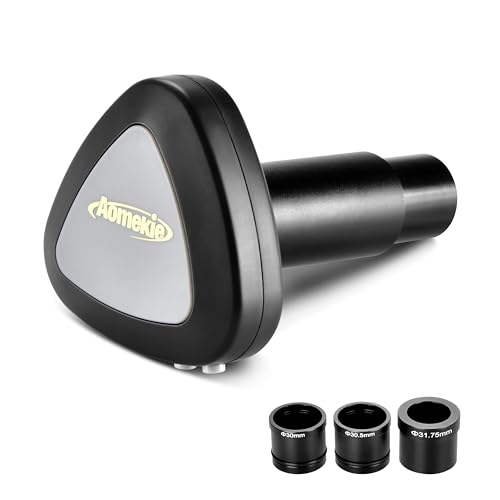
AOMEKIE’s digital eyepiece includes three adapter rings to fit a variety of telescopes and microscopes, plus WiFi for real-time viewing on mobile devices or a laptop. A built-in 800 mAh battery provides 60–90 minutes of use, offering portable observation sessions away from power outlets. The camera supports 1080P video and 2MP stills, aligning with many hobbyist needs for detailed imagery during fieldwork.
WnewTools 16MP 1080P USB C-Mount Digital Microscope Camera

This USB camera supports direct live viewing on high-definition displays via HDMI and is designed to work with compatible microscopes. It emphasizes high resolution and reliable image transfer to monitors, making it suitable for classroom demonstrations or lab documentation where a clear, connected feed is essential.
AmScope MD300A: 3MP USB Color CMOS Eyepiece Camera

AmScope’s MD300A offers 3MP imaging with USB connectivity and Windows-compatible software for editing, stitching, EDF, and measurements. It supports various platforms through DirectShow and LabVIEW, providing a robust toolset for researchers or educators who requirepost-processing features and accurate image analysis alongside live capture.
AmScope MD1500: 5 MP USB Digital Eyepiece Camera

This AmScope option provides 5MP image capture and live video streaming across Windows, with compatibility extending to editing and measurement features. The included software suite supports stitching and color control, and the device is designed to integrate smoothly with most standard microscopes, expanding capabilities for documentation and analysis in education or research settings.
Buying Guide: Key Purchase Considerations
- Compatibility: Confirm the eyepiece size (commonly 25–50 mm) and whether adapters are included or sold separately for your microscope or telescope.
- Resolution and Video: For detailed observations, aim for at least 1080P video with 2–12 MP still image capability. Higher MP often benefits post-processing and cropping.
- Connectivity: USB vs. WiFi options affect workflow. USB cameras commonly pair with a PC; WiFi cameras allow mobile control and offline operation in field conditions.
- Software: Consider bundled software for editing, stitching, measurements, and compatibility with Windows, macOS, or Linux. Some cameras offer advanced features like EDF or time-lapse.
- Power and Portability: Built-in batteries are helpful for fieldwork; verify battery life and whether external power is required.
- Durability and Build: A metal chassis enhances durability for classroom or field use, while lightweight designs improve portability.
- Price-to-Performance: Balance image quality, ease of use, and software features against cost. For beginners, simpler interfaces may offer faster results.
- Use Case: Define primary goals—education, hobbyist observation, astrophotography, or professional documentation—to choose features like time-lapse, high frame rates, or streaming stability.
These considerations help compare options across the listed products, ensuring selection aligns with user needs, whether for classroom demonstrations, home microscopy, or field observations. The right camera eyepiece can simplify imaging workflows while preserving image integrity and ease of sharing research.