Capturing the night sky requires specialized camera lenses and accessories designed to optimize image clarity, sensitivity, and precision. Whether you are an amateur astronomer or a seasoned astrophotographer, selecting the right gear is essential for dazzling shots of stars, planets, and lunar landscapes. Below is a summary table of the top products ideal for astrophotography, highlighting their main features for quick reference.
| Product | Brand | Main Features |
|---|---|---|
| Canon EF-S 24mm f/2.8 STM Lens | Canon | Wide angle, 24mm focal length, f/2.8 aperture, slim and lightweight |
| SVBONY SV105 Telescope Camera | SVBONY | 1.25″ IMX307 CMOS sensor, plug & play, suitable for lunar and planetary imaging |
| SVBONY SV905C Guide Camera | SVBONY | 1.23MP CMOS, high sensitivity, USB 2.0 interface, autoguiding compatible |
| NEEWER USB Lens Heater | NEEWER | Lens warmer for dew prevention, 3 temperature settings, USB powered |
| FIBONAX 4K 8MP Telescope Camera | FIBONAX | 8MP sensor, 4K video, IR filter, plug & play multi-OS support |
Canon EF-S 24mm f/2.8 STM Wide Angle Lens

The Canon EF-S 24mm f/2.8 STM Lens is a wide angle lens designed specifically for Canon APS-C cameras, offering a 38mm equivalent focal length on full-frame cameras. Its maximum aperture of f/2.8 allows for sufficient light intake crucial for night sky photography. Weighing as the slimmest and lightest in the EF-S lineup, it provides excellent portability and ease of use during long astrophotography sessions. The lens offers a maximum magnification of x0.27, allowing for detailed shots of celestial bodies. It is ideal for wide-field astrophotography capturing expansive star fields and the Milky Way.
SVBONY SV105 Telescope Camera for Beginners
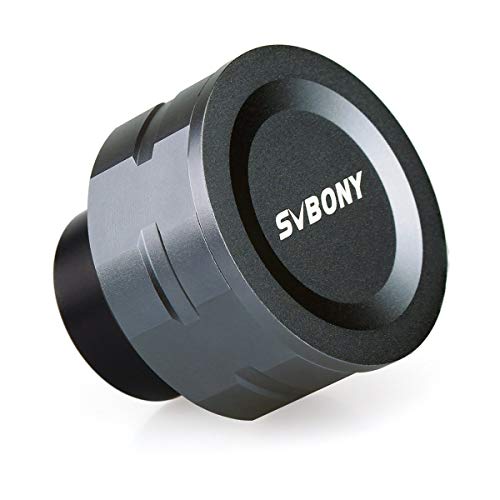
The SVBONY SV105 is an electronic telescope eyepiece camera ideal for beginners in astrophotography. Equipped with a 1.25-inch diameter and an IMX307 CMOS color sensor, it allows lunar, planetary, and bright celestial object imaging. This camera supports real-time viewing by transferring live images to a laptop or PC, facilitating dynamic observation. Compatible with Windows, Linux, and Android via different software solutions, it requires no additional drivers and works on plug-and-play. Its compact design and simplicity make it an accessible entry point for capturing detailed views of the moon and planets.
SVBONY SV905C Astrophotography Guide Camera

The SVBONY SV905C Guide Camera features a 1.23-megapixel CMOS sensor with 1280×960 resolution and 3.75-micron pixel size, providing high sensitivity for guiding and planetary imaging. Its AR-coated sensor ensures high QE peaks of up to 80%, capturing faint stars which enhances autoguiding precision during long exposure astrophotography. The device supports USB 2.0 and ST4 guide star output, making it compatible with popular guiding software such as PHD2 and MDL. The camera’s CS interface accommodates CS or C-mount lenses, increasing versatility for varying imaging setups.
NEEWER USB Lens Heater for Dew Prevention

The NEEWER USB Lens Heater is an essential accessory to tackle dew, fog, and condensation issues during cold weather astrophotography. It fits lenses and telescopes up to 12 inches (300mm) in length. Powered via USB, it includes a 4.9ft cable compatible with portable chargers and power adapters, making it versatile for outdoor use. With three adjustable temperature settings ranging from 35°C to 65°C, users can easily adapt to different environmental conditions. This lens warmer safeguards optical components, ensuring clear images without moisture interference.
FIBONAX 4K 8MP Telescope Camera with IR Filter

The FIBONAX 4K 8MP Telescope Camera combines high-resolution imaging with user-friendly features. It comes with an 8-megapixel sensor capable of recording 4K video at 30fps and 1080p at 60fps, perfect for crisp planetary and lunar captures. This telescope electronic eyepiece includes an IR-cut filter to minimize light pollution and protect the sensor. Plug & play compatibility across Windows, macOS, and Linux eliminates driver hassles. The camera fits all standard 1.25-inch telescope focusers, providing seamless integration for advanced astrophotography and electronic assisted astronomy (EAA).
Buying Guide for Astrophotography Camera Lenses and Accessories
Lens Focal Length and Aperture
The focal length determines how much sky you can capture. Wide-angle lenses (such as 24mm) are excellent for capturing expansive night skies, while lenses with moderate focal lengths (50mm) offer more zoomed-in celestial detail. A wide maximum aperture (f/2.8 or lower) is crucial for allowing sufficient light, improving star visibility and image brightness in low-light conditions.
Camera Sensor Sensitivity and Resolution
For astrophotography, cameras with high sensitivity sensors like CMOS or back-illuminated sensors reduce noise and capture faint celestial objects. Resolution impacts image detail—higher megapixels allow for more detailed shots but require more storage and processing power. Cameras like the SVBONY SV905C offer a balance suitable for planetary imaging and autoguiding.
Compatibility and Mounting Options
Consider whether the lens or camera is compatible with your existing DSLR or telescope setup. Adapters such as the SVBONY T2 T Ring Adapter facilitate attaching cameras to telescopes for prime focus astrophotography. Ensure mount compatibility (e.g., Canon EF mount) to avoid incompatibility issues.
Dew Prevention Accessories
Condensation on lenses and telescopes can ruin astrophotography sessions. Using devices like the NEEWER USB Lens Heater helps maintain optical clarity by preventing dew and fog, especially during long exposures at night and in cooler weather.
Portability and Ease of Use
For beginners and casual users, lightweight and compact lenses or cameras with plug-and-play operation simplify astrophotography without heavy setup complexity. Cameras that offer real-time viewing on laptops increase the convenience of framing and focusing on celestial targets.
Software and Operating System Support
Cameras with multi-OS support and compatibility with popular astrophotography software streamline image capture and processing. Ensure the device works smoothly with your computer OS (Windows, MacOS, Linux) and favored software (e.g., Sharpcap, AstroDMx, PHD2).