Speed, safety, and evidence-ready footage make modern dash cams essential for drivers. This guide highlights five top choices that balance Ultra HD recording, low-light vision, GPS, and reliable parking monitoring. Each product is explained with its standout features, so you can compare performance and decide which model fits your needs and budget. The selections emphasize dual-channel front-and-rear recording, advanced night vision, and convenient connectivity for quick sharing or reviewing footage.
| Product | Key Benefit | Resolution |
|---|---|---|
| TERUNSOUl 4K+4K Dash Cam | Dual 4K recording with large aperture for night vision | Front 3840×2160, Rear 3840×2160 |
| ROVE R2-4K DUAL Dash Cam | Sony STARVIS 2 sensor, fast WiFi app sharing | Front 3840×2160, Rear 1920×1080 |
| REDTIGER Dash Cam Front Rear | Excellent night vision with F1.5 lens | 4K + 1080p |
| ROVE R2-4K Dash Cam (WiFi 6) | WiFi 6, GPS, fast wireless transfers | Front 3840×2160, Rear 1920×1080 |
| 360 View 4 Channel Dash Cam (ZMOPO) | 360-degree coverage with interior lens | 1080p per channel |
Each model below is examined in detail to help you weigh image quality, storage flexibility, parking monitoring, and ease of use. All are suitable for American roads and legal in typical driving contexts, but you should verify local regulations and installation requirements before use.
TERUNSOUl 4K+4K Dash Cam Front And Rear
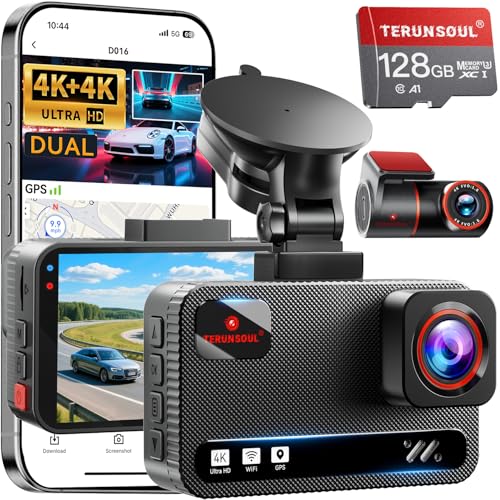
The TERUNSOUl dual-camera system records in 4K from both the front and rear channels, ensuring high-detail footage of roads and surroundings. The front camera features a wide 170° angle and an F1.5 aperture, while the rear uses an F1.8 aperture for improved low-light capture. A pre-installed 128GB card supports immediate recording, with loop recording to prevent overwriting crucial footage. The device also supports up to 512GB microSD cards, expanding long-term storage. Built-in GPS logs location data, while G-Sensor protection automatically locks critical clips after a collision. 24-hour parking mode helps capture events when the vehicle is parked. Night vision is enhanced by advanced WDR, delivering clearer colors and detail in varying light conditions.
Key points to consider: Dual 4K capture provides superior evidence quality, but file sizes grow quickly—ensure you have ample storage and consider offloading footage when convenient. The 170° front angle helps capture wide road scenes; however, extremely wide angles can introduce distortion at the edges. The included 128GB card is a good starter, but you may want to upgrade to 256GB or larger for longer monitoring periods. The built-in GPS and G-Sensor add reliability in evidence cases. Parking mode is a strong feature for overnight safety, though continued operation requires stable power and heat management in extreme climates.
ROVE R2-4K DUAL Dash Cam Front And Rear

The ROVE R2-4K DUAL emphasizes image quality with a Sony STARVIS 2 sensor in the front, delivering strong performance in mixed lighting. Front recording is 4K at 30fps, while the rear is 1080p, with a 150° front and 140° rear field of view to maximize coverage. The camera’s ultra-fast dual-band 5GHz/2.4GHz WiFi enables quick video transfers to a smartphone app, and firmware upgrades are managed over the air via the ROVE App. A built-in GPS feature records driving routes and speeds for mapping on Google Maps, adding a robust layer of evidentiary data. The device supports easy sharing and playback, which is helpful for quick incident reviews and insurance documentation.
Considerations include the potential for larger 4K file sizes; ensure you have appropriate storage and a reliable power supply, especially during extended trips. The app’s transfer speed is a plus for rapid sharing, but performance can vary with network conditions. The combination of STARVIS 2 sensor and F1.5 aperture helps with night driving, though you may still want to enable parking mode cautiously to avoid excessive power draw. A quality mount and tidy cabling will preserve the system’s reliability and visibility during daily use.
REDTIGER Dash Cam Front Rear

REDTIGER combines a 4K front camera with 1080p rear recording to capture critical details, including road signs and license plates, with a broad 170° front and 140° rear field of view. The camera’s night-vision performance is enhanced by a large F1.5 aperture lens and HDR/WDR processing to improve clarity in low-light conditions. Wireless connectivity via built-in Wi-Fi allows quick access through the companion app for playback, sharing, and settings management. The device supports 24-hour parking mode for extended surveillance when the vehicle is parked, ensuring ongoing evidence capture. A 32GB SD card is included to initiate use immediately, though higher capacities can be added for longer recording sessions.
Key considerations include balancing the strong daytime resolution with the rear camera’s 1080p for a cohesive evidence set. Night vision benefits from the high aperture, but in very dark environments, supplementary lighting or placement decisions can impact footage quality. The Wi-Fi/app experience is convenient for quick reviews, though you should be mindful of data transfer restrictions in certain locations. Overall, REDTIGER provides solid daytime and night coverage with practical parking monitoring support.
ROVE R2-4K Dash Cam With GPS
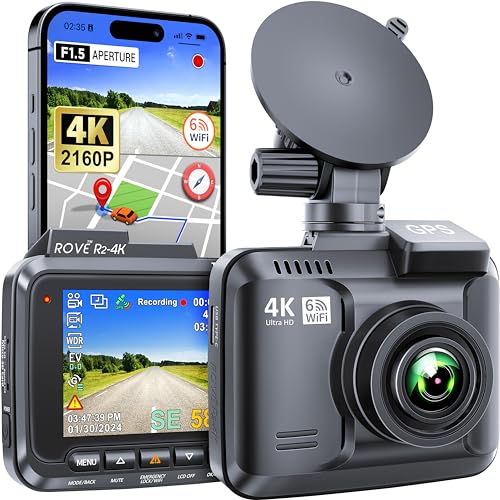
This ROVE model emphasizes built-in WiFi 6 for faster transfers and a 2160p front recording with a 150° wide lens, complemented by a 2.4″ IPS screen. The camera’s night-vision capabilities rely on Sony’s sensor and a wide aperture (F1.5) to maximize light intake. GPS logging adds precise trip data, and detailed route tracking can be reviewed through the ROVE App. The dash cam supports firmware updates over the air, ensuring continued feature improvements and security enhancements. Parking mode helps document incidents while the car is parked, yet power management remains a practical consideration for extended use.
Pros include rapid wireless sharing and a modern GPS experience, while a potential trade-off is the shorter rear recording resolution compared to the front. For drivers prioritizing front-end clarity and route tracking, this model offers a reliable and user-friendly option with strong overall performance. Ensure you pair it with a suitable storage strategy to maximize efficiency and evidence readiness.
360 View 4 Channel Dash Cam (ZMOPO)

The ZMOPO 360-degree dash cam provides four lenses to cover front, rear, left, and right perspectives, with an interior camera for cabin monitoring. This setup yields a near-360-degree field of view to minimize blind spots, which is beneficial for comprehensive incident documentation. A Time-Lapse Recording option helps compress footage during parking mode, saving memory space. The package includes a 128GB card, though the system often requires an ACC hardwire kit with a GPS module to enable parking monitoring and low-voltage protection for battery health. Night vision and WDR technology enhance image quality across varied lighting conditions.
Consider that 360-degree options can create a lot of video data, so you’ll want robust storage and a clear mounting strategy to avoid obstructing drivers’ views. The interior lens adds valuable cabin footage but may raise privacy considerations depending on usage. This model suits users seeking full situational awareness around a parked or moving vehicle and who are comfortable with more complex installation requirements that leverage a GPS module for best results.
Dash Cam Front and Rear Ecomoment GT802
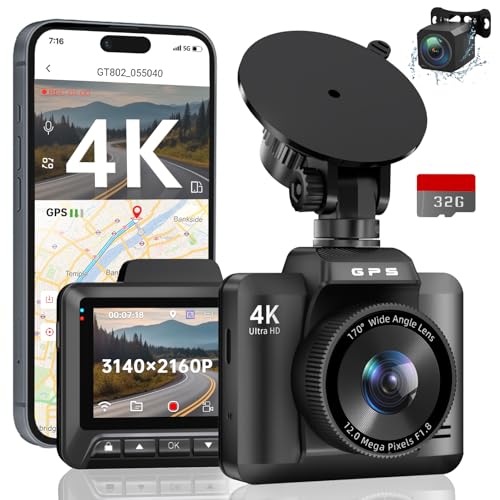
Ecomoment GT802 offers 4K front and 1080p rear recording on a compact 2.4-inch IPS display. The 170° wide front lens provides broad road coverage, with WDR and night-vision capabilities to improve clarity under challenging lighting. GPS is built-in to log location and speed, and the camera supports OTA firmware updates via its app, enabling ongoing improvements and feature additions. The device includes a 32GB SD card to get started and supports loop recording with a G-sensor that locks videos in the event of a collision, ensuring critical evidence remains intact. Parking monitoring extends surveillance when the vehicle is idle, making it useful for multi-stop or long-duration trips.
Potential trade-offs include the need for careful installation to avoid obstructing sensors and ensuring the front and rear cameras are aligned for optimal coverage. The GT802 is well-suited for drivers who want strong overall image quality with GPS-enabled route tracking and a straightforward app experience. As with other dash cams, plan for adequate storage and secure power management to sustain continuous operation during long drives.
Buying Guide
When choosing a dash cam system, consider the following:
- Resolution and field of view: Front 4K offers the best detail for license plates, but ensure your storage can handle large video files. A wide-angle lens reduces blind spots but may introduce distortion at the edges. Look for at least 150° front coverage and a rear camera that complements the setup.
- Low-light performance: Night vision is critical for accidents and insurance, so prioritize models with large apertures (F1.5–F1.8) and WDR/XDR processing. A high-quality sensor (e.g., Sony STARVIS) improves performance in dim conditions.
- GPS and speed data: Built-in GPS enables precise location and speed logging, which helps in reconstruction of events. Ensure the GPS data can be viewed on a compatible map app or GPS player.
- Parking mode and power management: Parking monitoring helps capture incidents when the car is stationary. Verify that the device includes reliable power management, loop recording, and low-voltage protection or offers an optional hardwire kit.
- Storage strategy: Consider the maximum supported microSD size and whether the device ships with a card. Large 4K recordings consume storage quickly, so plan for 128GB–256GB cards or higher for longer coverage.
- Connectivity: WiFi or app-based sharing can speed up viewing and download of footage, but firmware stability and app reliability vary. Consider models with OTA updates for ongoing improvements.
- Installation and compatibility: Ensure the dash cam fits your vehicle’s power system and that the mounting location doesn’t interfere with airbags or sensors. Professional installation may be worthwhile for complex systems, especially 360-degree or interior-camera configurations.
In selecting a model, align features with your priorities: maximum coverage and 4K image clarity may be ideal for evidence-heavy use cases, while more compact setups with robust GPS and app support can be better for everyday driving. Always verify local regulations regarding dash cam use and interior recording to ensure compliant and responsible use.