Landscape photography demands accurate light measurements to balance shadows, highlights, and color. The following light meters are selected for landscape work, offering reliable lux readings, intuitive controls, and compatibility with a variety of cameras and lighting setups. Each product features a range of lux measurements, data hold, and display options to help photographers capture consistent landscapes from sunlit ridges to shaded valleys.
| Product | Brand | Key Feature |
|---|---|---|
| Light Meter Digital Illuminance Meter Handheld Ambient Temperature Measurer | URCERI | Lux range up to 200,000; ambient temp; 4-digit LCD |
| Sekonic L-308X-U Flashmate Light Meter | Sekonic | Ambient and flash readings; wide ISO/stop range |
| UNI-T UT383 Light Meter Lux Meter | UNI-T | 0–199,900 Lux; FC; high accuracy; auto shutdown |
| Digital Illuminance Light Meter 0~200,000 Lux (Ohcans) | Ohcans | 180° rotating sensor; backlit display; wide scene coverage |
| TopTes TS-710 Light Meter | TOPTES | 180° rotating sensor; 0.1–200,000 Lux; backlit display |
Light Meter Digital Illuminance Meter Handheld Ambient Temperature Measurer
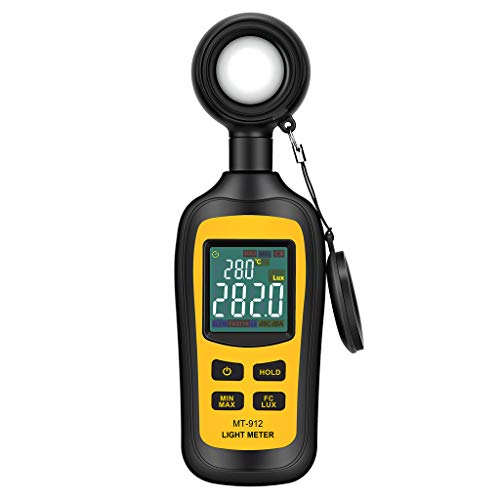
The URCERI digital illuminance meter offers a wide lux range up to 200,000 and also measures ambient temperature. It provides high measurement accuracy with a declared tolerance of ±3% across most ranges, improving field reliability for landscape work under variable sun and shade. The device features a four-digit color LCD display, MIN/Max readings, data hold, auto power off, and low-battery indication. For outdoor scenes with changing light, this meter helps determine exposure targets and assists in balancing highlights with shadows when photographing sunlit foregrounds against darker backgrounds. Its combination of lux and ambient temperature readings can also aid in white balance considerations over the course of a shoot day.
Key considerations for this model in landscape work include the device’s broad lux range, readable LCD, and practical data features. Users should note that while it provides robust lux data, it lacks specialized flash metering modes, so it suits scenes where ambient light dominates. The device supports on-site decisions about exposure and post-processing consistency, helping photographers maintain consistent results across sequences and locations.
Sekonic L-308X-U Flashmate Light Meter

The Sekonic L-308X-U Flashmate is a compact, reliable choice for landscape photographers who also work with flash or strobe setups in outdoor environments. It provides precise ambient exposure readings and dedicated flash measurements, including a full-stop display and a tenth-stop precision in ambient mode. The meter’s wide range covers typical outdoor lighting from dawn through bright noonday sun. In practice, the L-308X-U supports a practical balance between ISO 100 ambient exposure ranges and flash exposure, letting photographers pre-visualize how strobe or fill flash will interact with natural light in scenic settings. It also supports camera-specific display configurations for still imagery and can help calibrate exposure across multiple shots in a single landscape session.
Landscape-specific considerations include its ability to measure ambient and flash light simultaneously, aiding field decisions when a scene benefits from subtle fill light or backlighting. Its compact form factor makes it easy to carry on hikes, but users should be mindful of battery management and the need to switch between ambient and flash modes when planning a shoot sequence across rapidly changing light conditions.
UNI-T UT383 Light Meter Lux Meter

The UNI-T UT383 is a compact digital illuminance meter designed to measure light intensity with high accuracy. It supports Lux and FC units, covering a broad spectrum of landscape applications—from natural daylight control for color grading to evaluating artificial lighting in location shoots. With a measurement range up to 199,900 Lux, the UT383 offers a practical balance of sensitivity and durability for field use. Its large, backlit LCD screen and auto shutdown help conserve power when shooting over long days. Features like MAX/MIN readings and data hold enable quick on-site comparisons across different parts of a landscape shoot, such as comparing sun-exposed ridges to shaded valleys on the same day.
Considerations for this meter include its portability and ease of use, which suit hikers and urban photographers alike. While it concentrates on ambient light measurement, integrating its readings with a tripod-based exposure strategy can help stabilize a series of landscape images with consistent tonality throughout a location shoot.
Digital Illuminance Light Meter 0~200,000 Lux (Ohcans)

The Ohcans AS803 light meter delivers a wide measurement range up to 200,000 Lux with a stated accuracy of ±4% rdg ±10 dgt, making it suitable for photos, plants, and interior design contexts. A standout feature is the 180° rotating sensor, which allows measurements from multiple angles—useful for evaluating lighting setups in uneven terrain or when shooting scenes that require precise angle consideration for illumination symmetry. The backlit LCD improves readability in shaded or low-light environments. Ohcans markets this device as versatile for photography, film, classroom, office, and indoor plant settings, highlighting its flexibility for landscape photographers who also manage controlled indoor light as part of a broader project.
Practical notes include its rotating sensor for flexible measurement positions and the backlit display for dawn or dusk shoots. While the device is designed for broad use, landscape photographers should assess whether the rotation range aligns with their typical shooting angles and whether a slightly larger screen or additional features (like continuous sampling) would enhance field usability for longer treks.
TopTes TS-710 Light Meter

The TopTes TS-710 light meter offers a 180° rotating sensor and a fast-responding measurement cycle, sampling every 0.5 seconds to deliver timely exposure data. It measures in a wide lux range from 0.1 to 200,000 and provides both lux and foot-candle readings, making it versatile for daylight and artificial lighting in landscapes. The backlit 2.25-inch LCD screen ensures readability in early morning or late evening shoots. With an accuracy specification of 3% rdg + 5 dgt and the option to work in various modes (LUX/FC, auto modes, and manual adjustments), this meter supports careful exposure planning for scenes with strong contrast, such as sunlit fields with shaded borders or dramatic horizon lighting.
For landscape shooters, the TS-710’s rotating sensor and broad measurement range enable flexible positioning and quick comparisons across different parts of a scene. It is well suited for photographers who want a straightforward tool that scales across both natural and artificial lighting conditions on location.
Buying Guide: Key Purchase Considerations For Landscape Photographers
- Measurement range and units: Look for devices that cover lux up to at least 200,000 and offer both Lux and FC readouts for adaptability across scenes.
- Sensor design and angle flexibility: Rotating or pivoting sensors help measure light from difficult angles found in terrain or architecture within landscapes.
- Display readability: A backlit LCD or high-contrast display improves readability in early morning, late evening, or shaded environments common in landscapes.
- Ambient vs. flash capabilities: If you frequently incorporate flash or reflectors in outdoor shoots, choose meters that can measure ambient and flash simultaneously or provide reliable flash data.
- Power management: Auto power-off, low-battery indicators, and energy-efficient operation are practical for long field sessions without frequent battery changes.
- Portability and build: Compact, rugged designs suit fieldwork; weigh the trade-offs between screen size, interface complexity, and overall durability.
- Data handling: Features like data hold, MIN/MAX readings, and quick comparison across multiple spots help in creating a cohesive landscape exposure plan.
- Price-to-performance: Balance the need for specialized features with budget, prioritizing meters that offer essential ambient exposure data and consistent measurement accuracy.
- Compatibility with workflow: Consider how readings integrate with your camera profiles, RAW processing, and grading pipelines to ensure consistent results across locations.
- Vendor support and documentation: Clear manuals and responsive customer support help when integrating a new tool into a photographer’s kit.