Whether you’re a beginner or an enthusiast, capturing stunning night-sky images requires a telescope that balances light-gathering power, image clarity, and easy photography integration. The following selections emphasize high-quality optics, sturdy mounts, and practical photo capabilities, helping you photograph craters, distant galaxies, or a bright lunar surface with reliability and ease.
The table below summarizes five strong choices for astrophotography, highlighting aperture, focal length, and notable features to help you compare at a glance.
| Product | Brand | Aperture / Focal Length | |
|---|---|---|---|
| MEEZAA Telescope | MEEZAA | 90mm / 800mm | Fully multi-coated optics; AZ mount; phone adapter; great for beginners to intermediate; 32x–240x with 3x Barlow |
| HETEKAN Telescope | HETEKAN | 90mm / 1000mm | High light-gathering; 40x–500x; dual phone mounts; two eyepieces + 3x Barlow |
| ZWO Seestar S50 | ZWO | Compact, integrated system | All-in-one smart telescope; auto find & track; lightweight; includes camera and dew heater |
| HEXEUM Telescope | HEXEUM | 80mm / 600mm | Fully multi-coated optics; portable with phone adapter; wireless control; carrying bag |
| Dianfan Telescope | Dianfan | 90mm / 800mm | High transmission coatings; 32x–240x; zenith mirror; beginner-friendly setup |
MEEZAA: 90mm Refractor With Phone Adapter

The MEEZAA telescope is designed for adults and beginners, featuring a 90mm aperture and an 800mm focal length. Its fully multi-coated optics maximize light transmission for brighter, clearer images. With adjustable magnification from 32x to 240x through two eyepieces and a 3x Barlow lens, it helps capture lunar detail and planetary features. An AZ mount supports intuitive aiming, while included accessories like a phone adapter and carry bag support convenient on-the-go astrophotography and education sessions.
HETEKAN: 90mm Refractor For Beginners

The HETEKAN telescope emphasizes brightness and detail with a 90mm aperture and a 1000mm focal length. It delivers a versatile 40x–500x magnification via 25mm, 10mm, and 6mm eyepieces plus a 3x Barlow lens. This setup provides solid options for wide-field sky viewing and close-up planetary observations. Dual phone mount options enable steady image capture with smartphones, making it suitable for social sharing and documenting stargazing sessions.
ZWO Seestar S50: All‑In‑One Smart Telescope

The Seestar S50 provides an all-in-one solution for beginners and experienced users who want a compact, semi-automatic setup. It integrates a telescope, electronic focuser, an astronomical camera, ASIAIR, altazimuth mount, and dew heater in a lightweight 2.5 kg body. The system promises crisp, low-noise images and simplified image capture with automated go-to and live star databases, reducing manual alignment and enabling straightforward astrophotography sessions.
HEXEUM: 80mm Aperture Portable Refractor
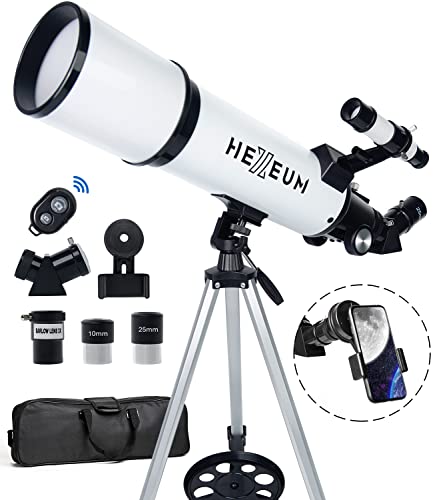
HEXEUM offers an 80mm aperture with a 600mm focal length, optimizing light capture for brighter images. The telescope uses full multi-coated optics and includes a phone adapter and adjustable tripod for flexible positioning. A wireless remote control and carrying bag add convenience for portable photography sessions, enabling quick setup at different observing sites.
Dianfan: 90mm Aperture 800mm Refractor

Dianfan’s 90mm aperture and 800mm focal length deliver bright, vivid views with high-transmission coatings to boost contrast. The included 32x–240x magnification range comes from two eyepieces and a 3x Barlow lens, and a zenith prism keeps images upright for terrestrial viewing. The setup is designed for beginners and families, with straightforward assembly and a lightweight frame that supports stable image capture onto devices via a phone adapter.
Buying Guide: Key Purchase Considerations
- Purpose and target targets: Lunar detail, planetary shots, or deep-sky objects. Higher focal length improves reach but can complicate tracking for live photography.
- Aperture and light transmission: Larger apertures gather more light, enabling brighter images, especially under light-polluted skies.
- Optical coatings: Fully multi-coated lenses reduce reflections and glare, improving brightness and contrast.
- Mount type and stability: Equatorial mounts offer smoother tracking for long exposure photos; alt-azimuth mounts are simpler but may require manual adjustments.
- Magnification options: Be wary of very high magnification; image stability and aperture quality matter more for photography clarity.
- Photography integration: Phone adapters and dedicated astrophotography accessories streamline image capture and sharing.
- Portability vs. performance: Lightweight, portable kits are convenient for on-the-go images but may compromise some capabilities.
- Future expandability: Consider compatibility with cameras, additional eyepieces, or motorized mounts if you plan to upgrade.