Beginning astrophotography can be exciting yet overwhelming. This guide highlights five beginner-friendly telescopes that balance portability, image quality, and ease of use. Each pick supports solid celestial views, simple setup, and practical features for capturing starry images and planetary detail. Below you’ll find a quick product summary, followed by in-depth sections that explain what makes each model suitable for newcomers and how to choose the right one for your goals.
| Product | Brand | Aim For | Key Strength |
|---|---|---|---|
| ZWO Seestar S50 Smart Digital Telescope | ZWO | All-in-one beginner-friendly imaging | Compact, automatic GoTo, built-in camera |
| MEEZAA 90mm Aperture 800mm Refractor | MEEZAA | Bright deep-sky views for beginners | Multi-coated optics, versatile eyepieces |
| DWARFLAB Dwarf 3 Smart Telescope | DWARFLAB | Portable, all-ages use with 4K tracking | Ultra-light, dual imaging, cloud processing |
| HEXEUM 80mm Refracting Telescope | HEXEUM | Travel-friendly with solid optics | Multi-coated, easy setup, wireless control |
| Gskyer 70mm AZ Refractor | Gskyer | Budget-friendly starter telescope | Lightweight, remote shooting, versatile |
Seestar S50 Smart Digital Telescope

The Seestar S50 is a compact, all-in-one solution designed for beginners who want simple setup and automated imaging. It integrates a telescope, focal electronics, an astronomical camera, and control software, all in a lightweight package (~2.5 kg). Its GoTo functionality, live star database, and auto tracking help newcomers locate objects without extensive star-hopping, while the onboard camera supports initial astrophotography experiments. The device emphasizes clean, low-noise images and an intuitive workflow suitable for learning basic exposure and framing techniques.
MEEZAA 90mm Aperture 800mm Refractor

This MEEZAA refractor offers a 90mm aperture and 800mm focal length, delivering bright planetary and lunar detail with multi-coated optics for higher contrast. It includes two eyepieces and a 3x Barlow lens, enabling magnifications from about 32x to 240x. A German equatorial mount with slow-motion controls makes tracking smoother and easier for beginners, while a moon filter helps reduce glare during close lunar observations. The package is well-suited for families and new astronomers exploring both planetary and deep-sky targets.
DWARFLAB Dwarf 3 Smart Telescope

The Dwarf 3 emphasizes portability and intelligent automation. Its ultra-light design (about 3 lb) makes it easy to carry for field sessions, while dual imaging modes suit both day and night use. The 4K auto-tracking system automatically follows celestial objects and even wildlife, enabling sharper frames and longer exposures with minimal manual input. This model aims to provide a quick setup and repeatable results for beginner shooters who want to experiment with time-lapse and star trails without heavy equipment.
HEXEUM 80mm Refracting Telescope
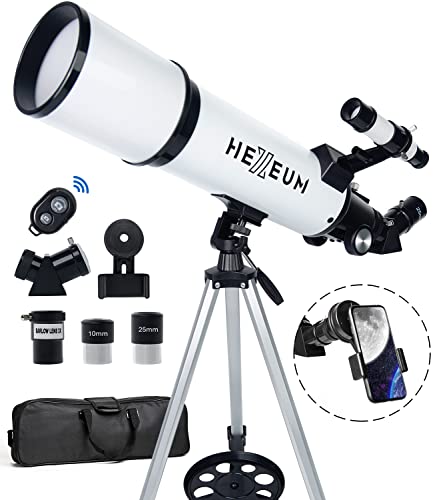
The HEXEUM 80mm model offers a portable refractor with a practical 600mm focal length and 80mm aperture, delivering improved light gathering for brighter images. It features multiple coated optics for higher transmission and clearer views, plus a 5×24 finder and a 3x Barlow option for growth in magnification. A wireless control option and a phone adapter support modern mobile photography workflows, making it a strong entry point for beginners who want to capture quick shots of the Moon, planets, and bright deep-sky targets while traveling.
Gskyer 70mm AZ Refractor

The Gskyer 70mm telescope provides an entry-level option with a 400mm focal length and a 70mm aperture, offering solid visual clarity and enough light for basic astrophotography experiments. It comes with two eyepieces and a 3x Barlow lens, enabling a range of magnifications. The wireless remote and phone adapter support easy image capture and remote operation, which is helpful for beginners who want to experiment with framing and composition while observing the Moon and planets. The kit’s portability makes it ideal for travel or classroom-style learning.
Buying Guide: Key Purchase Considerations For Beginners
- Purpose and targets: Decide whether you want planetary detail, bright deep-sky views, or general astrophotography. This will guide magnification needs and mount type.
- Optical quality: Look for multi-coated optics to maximize light transmission and reduce glare. For beginners, a brighter, clearer image reduces frustration and improves learning.
- Mount and tracking: Equatorial mounts and GoTo tracking help with long exposures and star trails, but simple alt-az mounts can be enough for beginners testing basic concepts.
- Portability and setup: If you plan to travel or observe outdoors frequently, prioritize lightweight designs and quick assembly.
- Imaging integration: Consider whether you want built-in cameras or external adapters for your smartphone or dedicated astrophotography cameras.
- Future expandability: Choose a model with compatible accessories (eyepieces, Barlow lenses, filters) to extend capabilities as skills grow.
- Software compatibility: Ensure companion apps or software support can help with star databases, alignment, and image processing basics.
- Budget and value: Balance initial cost with potential upgrades to avoid early obsolescence; focus on models that offer easy upgrades rather than complete overhauls.
Overall, beginners should prioritize ease of use, reliable optics, and helpful alignment features. Start with targets you can confidently resolve—the Moon, bright planets, and prominent deep-sky objects—then gradually experiment with longer exposures, stacking, and post-processing techniques to refine results.