Moisture and mold outbreaks are best caught early with accurate temperature imaging. The following five handheld thermal cameras are selected for mold detection tasks, combining high-resolution infrared imaging, smart detection features, and practical on-site usability. Whether you’re inspecting under sinks, basements, or wall cavities, these tools help identify hidden moisture, insulation gaps, and thermal anomalies that can indicate mold risk. The summary table below highlights the core specs and strengths of each model to help you compare quickly.
| Product | Brand | IR Resolution | Temp Range | Notable Feature | Typical Use |
|---|---|---|---|---|---|
| TOPDON TC004 Mini | TOPDON | 128×128 (enhanced to 240×240 via TISR) | -4°F to 842°F | Smart alerts and auto photo capture | Underfloor leaks, electrical hot spots, small spaces |
| HF96 | HSFTOOLS | 96×96 (live 240×240 with SR) | -4°F to 1022°F | IntellFault intelligent scene detection | Moisture leaks, insulation gaps, quick scans |
| HF96V | HSFTOOLS | 96×96 (Fusion/240×240 SR) | -4°F to 1022°F | Dual IR/visible cameras, scene detection | Detailed imaging with visible context |
| TOPDON TC004 | TOPDON | 256×192 (TC004) | -4°F to 662°F | PC analysis and video recording | Detecting moisture-led anomalies, HVAC checks |
| F2W | HSFTOOLS | 256×192 to 640×480 SR | -4°F to 1022°F | Wide SR and intelligent scene detection | Comprehensive mold risk inspections, reporting |
The following product sections provide concise, objective overviews to help you match features to mold detection needs, including image clarity, temperature sensitivity, and data capture capabilities.
TOPDON TC004 Mini Handheld Thermal Camera

The TOPDON TC004 Mini starts with a 128×128 infrared resolution that can be enhanced to 240×240 using TISR technology, delivering clearer details in confined spaces common to mold-prone areas. It covers a wide 40°x 30° field of view with a 25Hz refresh rate for smooth, navigable live views, helping pinpoint moisture more accurately in walls, ceilings, and under sinks. Temperature measurement ranges from -4°F to 842°F, enabling quick spotting of warm and damp zones that precede mold growth.
Smart alerts trigger on preset temperature thresholds, and the device automatically captures photos as problems appear, supporting documentation for remediation planning. The TC004 Mini also supports manual photo capture and offers ample onboard storage (512MB eMMC) to store thousands of images, which is useful for tracking mold risk progression during a project. Five color palettes help adapt visualization to indoor environments and user preference.
HF96 Thermal Camera

The HF96 combines a compact 96×96 IR core with live super-resolution that upgrades to 240×240 for enhanced visibility of moisture pathways and insulation gaps. Its intelligent IntellFault scene detection helps automate the identification of leaks and voids, reducing manual interpretation time when tracing mold-prone areas behind walls or under flooring. A built-in laser pointer and thermometer make on-site spot checks more efficient, while the device supports image and video capture and palette switches to optimize visualization in varying lighting conditions.
HF96V Thermal Camera With Visual Camera
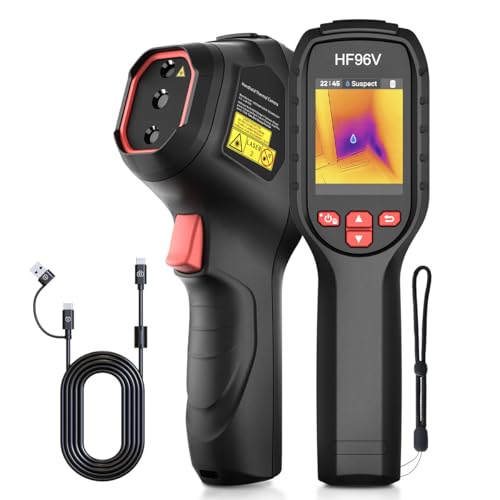
The HF96V adds a dual-camera setup: a 96×96 IR sensor plus a 640×480 visible camera, producing fused images for better context when inspecting potential mold sites. Three image modes (Fusion, Thermal, Visual) and seven color palettes offer flexible visualization for detecting moisture-related heat signatures. The IntellFault automation supports rapid scene detection, helping identify leaks and insulation gaps that mold often follows, while the included accessories and firmware updates ensure the tool remains current for ongoing inspections.
TOPDON TC004 Thermal Imaging Camera

The larger TOPDON TC004 model features a 256×192 IR resolution and 32GB of memory with a 12-hour battery life. It supports PC analysis and video recording, enabling more robust documentation for mold remediation projects. The camera can connect to a Windows PC for online analysis, 3D imaging, and detailed temperature reporting. A high temperature range and fast 25Hz frame rate provide responsive performance when scanning larger interiors such as basements or multi-room crawl spaces, assisting in identifying persistent moisture hotspots.
F2W Thermal Imaging Camera

The F2W offers a powerful combination: 256×192 IR resolution enhanced to 640×480 via live Super Resolution, with a 3.2-inch LCD for clear on-screen viewing. The 25Hz frame rate maintains smooth imaging for rapid surveys of damp walls and joists. Its IntellFault intelligent scene detection analyzes environmental data to flag leaks and insulation voids, making it well suited for mold risk assessments. An app and Windows PC software provide options for sharing images, generating reports, and performing deeper analysis with 3D plotting and real-time monitoring.
Buying Guide: What To Consider For Mold Detection
Purpose and environment: For residential mold risk assessments, prioritize devices with high thermal sensitivity (low millikelvin values), reliable moisture-path visualization, and ease of use in tight spaces. A device with both IR and visible imaging helps correlate hot spots with actual moisture sources.
Resolution and image quality: While higher IR resolution improves detail, consider whether you need real-time SR enhancements (like 240×240 from 96×96 cores) for clearer traceability of moisture pathways behind materials such as drywall and insulation.
Temperature range and accuracy: Mold-related moisture often involves minor temperature differences. Look for cameras with tight accuracy (±1°C or ±0.5°C if available) and a wide range that can cover typical indoor environments.
Data capture and reporting: Built-in photo/video capture, memory capacity, and PC or mobile app integration help document findings and produce remediation reports. Consider whether you need professional-grade analysis tools or simple on-site checks.
Smart features: Scene detection (IntellFault or similar), adjustable palettes, and automated warnings can speed up inspections by highlighting anomalies without manual interpretation.
Battery life and form factor: For attic, basement, or crawlspace inspections, a long-lasting battery and compact design reduce interruptions. Some models include auto-shutdown to preserve power, which is useful during extended projects.
Compatibility and expansion: If you already rely on a specific device ecosystem (PC software, iPhone/Android compatibility), ensure the camera supports your preferred workflow, including firmware updates and data export formats.
Budget and total cost of ownership: Alongside initial price, factor in memory capacity, accessories, software subscriptions, and warranty terms to determine cost per inspection over time.
In mold detection work, the goal is to reveal moisture patterns that precede visible mold growth. The five cameras above offer varying balances of image clarity, smart analysis, and data management. Selecting the right tool depends on your typical spaces, reporting requirements, and whether you need portable, on-the-spot guidance or deeper post-inspection analysis.