For Micro Four Thirds shooters, wide angle lenses unlock dramatic perspectives whether you’re capturing sweeping landscapes, tight interiors, or cityscapes. This article highlights a curated set of wide angle options that maximize image quality, sharpness, and versatility on MFT cameras. Each lens is evaluated by aperture, optics, and handling, so you can compare performance across brands and price points.
Summary of chosen products:
| Product | Brand | Focal Length / Max Aperture | Notable Strengths |
|---|---|---|---|
| Rokinon 12mm f/2.0 | Rokinon | 12mm f/2.0 | Ultra-wide, bright, minimal distortion, strong edge-to-edge sharpness |
| Panasonic LUMIX 25mm f/1.7 | Panasonic | 25mm f/1.7 | Natural field of view (50mm eq.), fast, compact, good bokeh |
| Rokinon 10mm f/2.8 ED AS NCS CS | Rokinon | 10mm f/2.8 | Very wide perspective, edge-to-edge clarity, NCS coating |
| Sigma 16mm f/1.4 DC DN Contemporary | Sigma | 16mm f/1.4 | Bright, fast, wide for APS-C sensors on MFT, superb sharpness |
| Meike 35mm f/1.4 | Meike | 35mm f/1.4 | Wide-angle feel on MFT, shallow depth of field, good value |
Rokinon 12mm f/2.0 NCS CS Wide Angle Lens for Micro Four Thirds

Rokinon’s 12mm f/2.0 provides a broad 98.9-degree field of view, tailored for APS-C sensors in this MFT context. The optical design includes 12 elements in 10 groups with three extra-low dispersion elements and two aspherical elements to limit distortions and chromatic aberration. The Nano Coating System helps suppress flare, preserving contrast in bright or backlit scenes. This lens is all about sharp landscapes, cityscapes, and interior shots where edge-to-edge performance matters, with minimal distortion at the edges for straight architectural lines.
Panasonic LUMIX 25mm F1.7 ASPH

Panasonic’s 25mm f/1.7 offers a natural 50mm equivalent field of view on Micro Four Thirds, making it a versatile everyday prime with a bright f/1.7 aperture. It is compact and lightweight, suitable for travel and street photography, while still delivering solid performance for environmental portraits and architectural details. The optical construction includes eight elements in seven groups, with aspherical and UHR elements to help minimize aberrations and preserve clarity across the frame.
Rokinon 10mm f/2.8 ED AS NCS CS

Designed for Micro Four Thirds, this 10mm ultra-wide offers an edge-to-edge coverage with a 110-degree angle of view. It features Nano Crystal Coating System to boost light transmission while reducing reflections, and a fast f/2.8 maximum aperture for low-light work or creative shallow depth of field. The internal optical design emphasizes minimal distortion across the frame, making it a strong choice for dramatic landscapes, architecture, and interior photography where perspective is key.
Sigma 16mm f/1.4 DC DN Contemporary

The Sigma 16mm f/1.4 DC DN Contemporary is a bright wide-angle option optimized for APS-C-format mirrorless cameras, delivering a 24mm equivalent focal length. It uses a multi-element design to minimize aberrations and maximize resolution at wide-open aperture. The fast f/1.4 aperture is ideal for dim interiors and night scenes, while the compact build suits street and travel photography where a sturdy, high-performance lens is desired.
Meike 35mm f/1.4 Wide Angle Prime
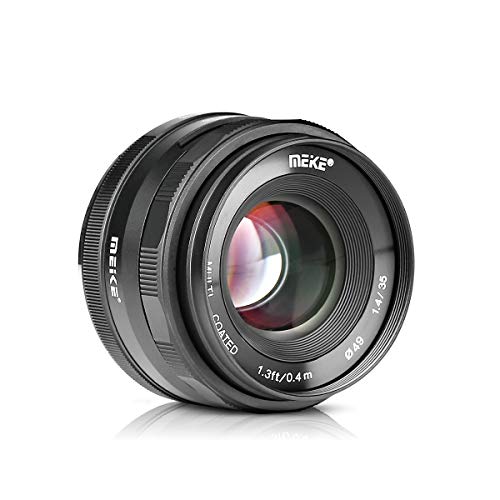
Meike’s 35mm f/1.4 for Micro Four Thirds offers a classic wide-angle perspective with a fast maximum aperture. The lens is structured with five groups and eight elements, designed to render smooth bokeh for portraits and environmental scenes while maintaining solid edge-to-edge performance. It’s a value-oriented option for creators who want a bright, manual-focus prime with a distinct perspective on MFT cameras.
Buying Guide: Key Considerations For Wide Angle MFT Lenses
When choosing a wide angle lens for Micro Four Thirds, consider field of view, maximum aperture, handling, and optical coatings. A broader angle (like 10mm–12mm) is ideal for dramatic landscapes and cramped interiors, but may introduce perspective distortion if not corrected in post. Fast apertures (f/1.4–f/2.8) help in low-light scenes and provide shallower depth of field for creative effects, though they can be more expensive or heavier. Image coatings such as nano or anti-reflective layers reduce flare when shooting against the sun or in backlit environments.
Focal length options cover a spectrum from ultra-wide to standard wide. Lenses with compact designs benefit travel and street work, while higher-grade glass may deliver crisper resolution and better color fidelity across the frame. For architecture and interiors, edge performance and minimal distortion at the periphery matter most, so look for aspherical elements and distortion-correction profiles. Many lenses also balance budget with performance, offering a practical middle ground for hobbyists and enthusiasts alike.
Compatibility and focus behavior are important: some lenses are native to Micro Four Thirds and provide reliable autofocus, while others are manual-focus only but can offer excellent optical quality and value. If you frequently shoot in low light, consider lenses with wider maximum apertures and coatings that suppress flare. Finally, check size and weight to ensure the lens complements your camera setup for extended shooting sessions.