When you need to analyze rapid action with crisp detail, a high-speed motion camera is the right tool. This guide highlights select models ideal for machine vision, sports analysis, and scientific observation. The top picks focus on fast frame rates, global shutter to prevent distortion, and adjustable optics for flexible distance needs. The best buyers are engineers, researchers, hobbyists, and anyone requiring clear slow-motion playback of fast events.
Buyer-focused quick reference:
- QILOVE Global Shutter USB Camera – 800P Monochrome Ultra High Speed: Best for distortion-free grayscale observation and precise motion tracking in lab setups.
- QILOVE Global Shutter USB Camera – 800P with different focal length: Best for close-ups with flexible zoom in constrained spaces.
- Casio Exilim EX-FH20: Best for everyday enthusiasts needing a high-speed consumer camera with broad zoom.
- IFWATER Global Shutter 90fps USB Camera: Best for plug-and-play quick setups and versatile applications such as golf analysis and 3D printing monitoring.
- HTENG VISHI High Speed USB3.0 Color Camera: Best for fast data transfer and straightforward external triggering in industrial tasks.
| Product | Key Strength | Best For |
|---|---|---|
| QILOVE Global Shutter USB Camera (120/210/420/640fps, 5–50mm) | Global shutter, high frame rates, monochrome sensor | High-speed machine vision, ballistic tracking |
| QILOVE Global Shutter USB Camera (120/210/420/640fps, 2.8–12mm) | Compact zoom range, fast modes | Tight observation ranges, flexible focal length |
| Casio Exilim EX-FH20 | 20x Optical Zoom, 1000 FPS | General consumer sports and action capture |
| IFWATER Global Shutter 90fps USB Camera | Plug-and-play, 5–50mm zoom | Golf swing analysis, 3D printing monitoring |
| HTENG VISHI High Speed Camera | Industrial-grade USB3.0, 790fps | Industrial imaging with external triggers |
QILOVE Global Shutter USB Camera – 800P Mono, 640fps, 5–50mm Lens

This camera uses a global shutter to capture distortion-free monochrome images at high speed. It records at 160×120 resolution up to 640fps, with frame options including 120, 210, 420, and 640fps. The 5–50mm CS-mount varifocal lens provides 10x optical zoom for detailed distant observations, while adjustable focus and aperture suit various machine-vision scenarios. Best for researchers and technicians who need clean, smear-free grayscale footage of rapid events.
Best for: Lab analysts and engineers who require precise motion capture in low-light or high-contrast settings. This model is chosen for its broad high-speed range and high-quality monochrome imaging.
Caution: Monochrome sensor may not be suitable if color data is essential for your analysis.
QILOVE Global Shutter USB Camera – 800P Mono, 640fps, 2.8–12mm Lens

This variant pairs a 2.8–12mm CS-mount lens with global shutter, enabling 160×120 resolution at up to 640fps. The 4x optical zoom helps capture fast events at greater distances, with manual adjustments for focal length, focus, and aperture to tailor image quality. Best for compact rigs where space is limited but high-speed precision is needed.
Best for: Small labs or field setups where you need adjustable zoom without swapping lenses. Choose this if you require tighter framing than a wide-angle but still want speed.
Caution: Lens range is narrower than the 5–50mm option, which may reduce flexibility in very wide or very narrow setups.
Casio Exilim EX-FH20: 9.1MP, 20x Zoom, 1000 FPS

Casio’s consumer-grade high-speed camera delivers 9.1 megapixels with a 20x optical zoom and 1000 frames per second in specialized modes. It’s a strong pick for hobbyists and non-professional analytics where ease of use and a broad zoom range matter more than raw sensor performance. Best for hobbyist sports capture and quick action shots.
Best for: Enthusiasts seeking high-speed playback with a familiar point-and-shoot workflow. Choose if you want a broader optical zoom for general purpose action shots.
Caution: Not designed for industrial-grade machine-vision tasks requiring precise timing and monochrome data.
IFWATER Global Shutter 90fps USB Camera – 5–50mm, 10x Zoom
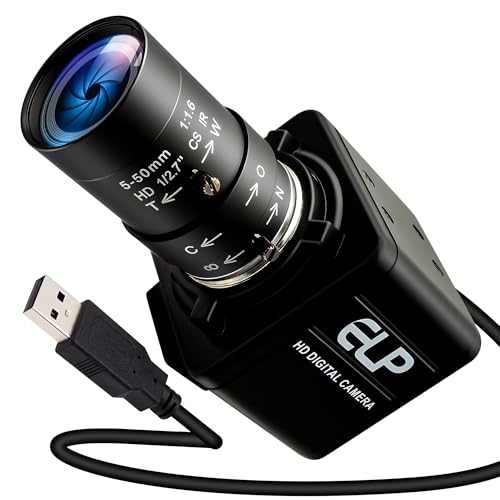
IFWATER’s camera uses a global shutter with up to 90fps at 1920×1080, plus a 5–50mm varifocal lens with 10x optical zoom. It’s designed as a plug-and-play solution via UVC, eliminating the need for extra drivers. Best for quick deployments in classrooms, labs, and field work where straightforward setup matters.
Best for: Users who want fast, simple setup and flexible focal adjustment without software dependencies. Choose this for easily scalable experiments and demonstrations.
Caution: 90fps, while excellent, is lower than some high-speed monochrome options and may not meet ultra-fast motion needs.
HTENG VISHI High Speed USB3.0 Color Camera

This industrial color camera offers high data transfer via USB 3.0 and a claimed 790fps in some setups. It also notes external triggering and SDK availability, indicating suitability for workflow automation and integration into larger imaging systems. Best for factories or labs needing reliable, fast capture with external control features.
Best for: Professional environments requiring robust data throughput and trigger-based capture. Avoid if color fidelity alone is the primary goal without high-speed constraints.
Buying Guide: Key Considerations When Selecting a High-Speed Motion Camera
- Frame rate requirements: Determine the minimum frames per second you need for your analysis. Higher fps captures faster events more clearly but can increase data size and complexity.
- Shutter type: Global shutter eliminates rolling shutter artifacts, essential for precise motion analysis. Monochrome sensors boost contrast in low light; color sensors help with scene context.
- Lensing and focus: Lens mount compatibility (CS-mount is common) and zoom range affect how you frame subjects at different distances. Manual focus can offer precise control for fixed setups.
- Connectivity and compatibility: USB3.0 or higher supports rapid data transfer. Check compatibility with your operating system and whether drivers or SDKs are needed for automation.
- Environmental and deployment needs: Consider size, weight, and whether the camera will operate in field conditions or stationary lab benches. Plug-and-play options save setup time.
- Data management: High-speed capture generates large files. Plan for storage, backup, and post-processing workflow compatibility (software for playback and analysis).
- Cost vs. capability: High-speed, high-resolution models offer more capability but at a higher cost. Match features to your primary use case to maximize return on investment.
Frequently Asked Questions
- What is the advantage of a global shutter? It captures the entire frame at once, preventing distortion when objects move quickly, which is crucial for accurate motion analysis.
- Do high-speed cameras require special software? Some do, especially for automation or analysis; others are plug-and-play via USB and work with basic video software.
- Is monochrome better for high-speed capture? Monochrome sensors often offer higher sensitivity and contrast in low light, aiding edge detection and motion clarity.
- What frame rate should I choose for sports analysis? For many sports, 120–420fps provides smooth slow-motion playback, but extremely fast actions may benefit from 640fps or higher if supported.
- Can these cameras be used with Raspberry Pi? Many models are listed as compatible or easily integrated with Raspberry Pi and other Linux-based systems via USB.
- What should I consider about lens choices? A wide to moderate zoom (e.g., 5–50mm) allows flexible distances, while shorter focal lengths are better for close-range shots and larger fields of view.